

Can what you say after an accident be used against you in California?
Yes and no. California law draws a line between expressing sympathy and admitting fault. Under Evidence Code section 1160, statements of sympathy or benevolence toward a person who has been hurt are generally not admissible to prove liability. But if, in that same moment, you say anything that amounts to self-criticism, that part can be admissible to prove fault after an accident. That is why we tell people to be very careful about what they say in the minutes after a crash.
Hurt in a crash? Our Los Angeles car accident lawyers offer a free case review, and you pay nothing unless we win. Call (866) 292-3051.
This is one of the questions we are asked most often, and the answer surprises people. Most drivers assume either that everything they say is fair game or that nothing said at the scene really matters. Neither is true.
What is the difference between sympathy and an admission of fault?
Sympathy is about the other person. Self-criticism is about you.
Telling someone “I hope you are okay” or “I am so sorry you are hurt” is an expression of sympathy toward a person you may have caused pain to. California’s rule on benevolent expressions exists precisely so that human decency at an accident scene is not punished.
Self-criticism is different. It is the moment the statement stops being about the injured person’s wellbeing and becomes a judgment about your own conduct. Once a statement crosses into that territory, it can come in as evidence of fault. The protection for sympathy does not carry the self-blame along with it.
Statements that tend to be treated as sympathy
- Asking whether the other person is hurt
- Saying you hope they are okay
- Offering to call 911 or help them out of the roadway
Statements that can be read as self-criticism
- Saying you were not paying attention
- Saying you were going too fast
- Saying you did not see the other car, the pedestrian, or the cyclist
- Saying the accident was your fault, or that you should have done something differently
You may say something like this out of shock, adrenaline, or plain politeness. It may not even be accurate. Many people apologize reflexively at an accident scene before they have any idea what actually happened, who had the right of way, or whether a light had changed. That does not stop the statement from being used later.
Why do these statements matter so much to insurance companies?
Because an early admission is cheap leverage. Insurance adjusters build a fault narrative fast, and a single sentence from the scene or from a recorded call can anchor the whole file. Our founder is a former insurance adjuster, so we have seen from the inside how quickly a comment like “I guess I wasn’t looking” gets logged, quoted, and repeated for the life of a claim.
It also matters because fault in California is often shared rather than all or nothing. Even a small shift in the fault allocation can change what a claim is worth. An off-the-cuff statement is exactly the kind of detail an insurer uses to argue that you carry a larger share than the evidence actually supports.
What should you do instead at the scene?
Keep it short, factual, and focused on safety.
- Check on everyone and call for help. Safety and medical attention come first, always.
- Exchange the information you are required to exchange. Name, contact details, insurance, license plate.
- Do not narrate your own driving. Skip any commentary on speed, attention, visibility, or what you should have done.
- Do not speculate. “I don’t know” is an honest and complete answer when you do not know.
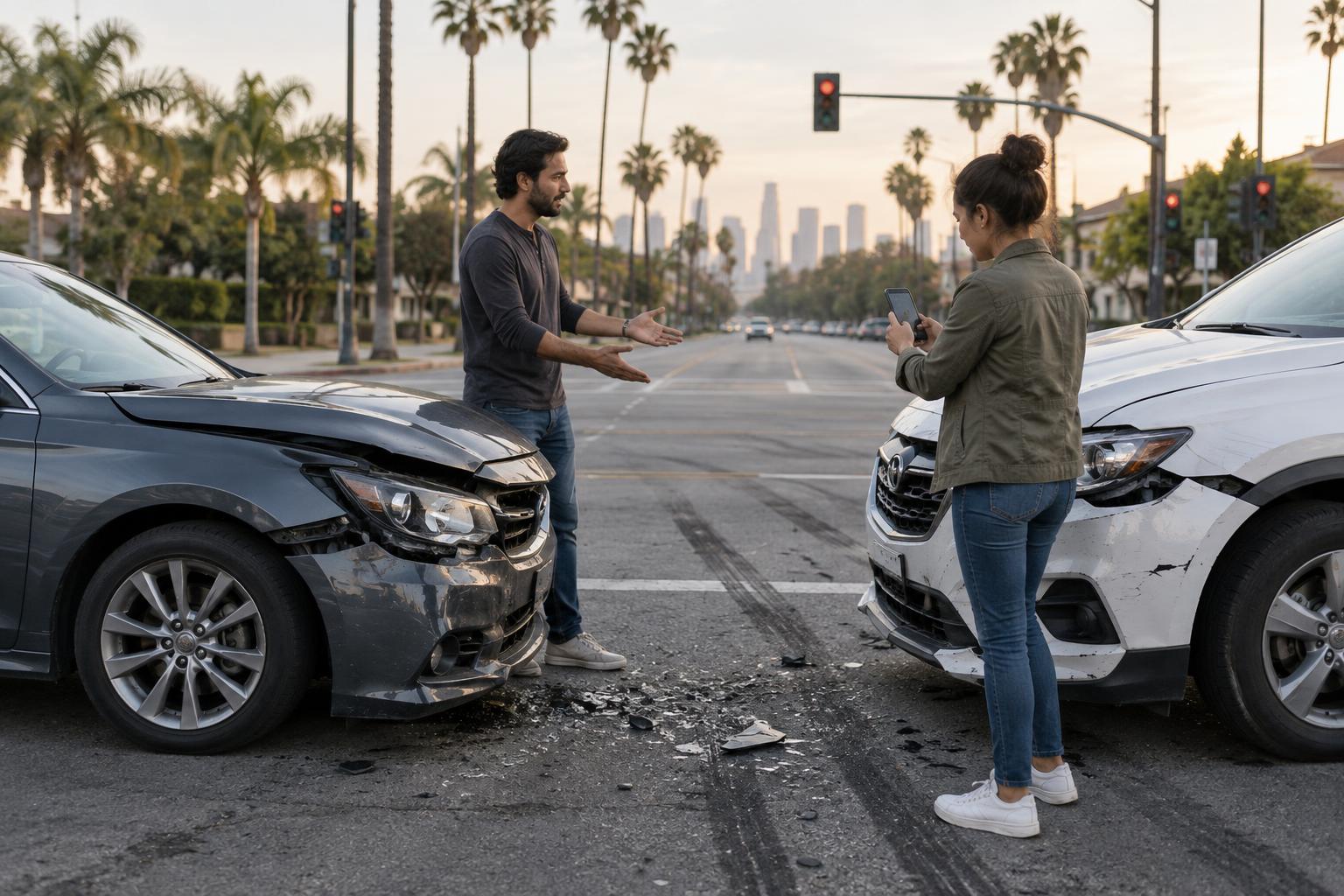
- Document instead of discuss. Photos of the vehicles, the roadway, signals, skid marks, and visible injuries do more for your claim than conversation does.
- Be careful with recorded statements. An adjuster may call quickly and sound friendly. You are not required to give a recorded statement to the other side’s insurer before you have spoken with an attorney.
This applies well beyond car crashes. The same dynamic plays out after truck accidents, motorcycle accidents, pedestrian accidents, rideshare accidents, e-bike and e-scooter injuries, bus accidents, and slip and falls. Anywhere fault is contested, your own words are one of the first things the other side goes looking for.
What if you already said something you regret?
Do not assume your claim is over. An early statement is one piece of evidence, not a verdict. It can be explained, put in context, or outweighed by the physical evidence, the vehicle damage, witness accounts, and the medical record. Shock and adrenaline at a crash scene are real, and a statement made in that state is not the same as a considered account of what happened.
What matters is that the rest of the claim gets built properly and that the statement does not go unanswered. That is the work: developing the evidence, pushing back on the insurer’s version, and negotiating from facts rather than from a stray sentence.
Frequently asked questions
Is saying “I’m sorry” after a car accident an admission of fault in California?
Not by itself. California’s benevolent expression rule generally keeps statements of sympathy from being used to prove liability, so saying you are sorry someone is hurt is usually protected. The problem arises when the apology includes self-criticism, such as admitting you were not paying attention. That portion can be admissible to prove fault.
What counts as self-criticism after an accident?
Self-criticism is any statement judging your own conduct rather than expressing concern for the other person. Comments about your speed, your attention, what you failed to see, or what you should have done differently all qualify. Under California law these statements can be admissible to prove fault, even though a pure expression of sympathy generally is not.
Do I have to give the other driver’s insurance company a statement?
No. You are not obligated to give a recorded statement to the other side’s insurer, and doing so early rarely helps your claim. Adjusters are trained to gather statements that limit payouts. At LA Injury Attorneys, we handle those communications so your words are not used to shift fault onto you.
What should I do first after an accident in Los Angeles?
Check on everyone, call 911, get medical attention, and document the scene with photos. Exchange required information without discussing how the crash happened or offering opinions about fault. Then speak with an attorney before giving statements to any insurer. LA Injury Attorneys offers a free consultation and is available 24/7 to answer your questions.
Talk to a Los Angeles personal injury attorney before you talk to an insurer
If you were recently in an accident and you are worried about something you said, or you are about to be asked for a statement, get advice first. Our team serves Los Angeles, Burbank, North Hollywood, El Segundo, and communities across California, and there are no fees unless we win.
Call 833-832-3397 or Schedule A Free Consultation.
Disclaimer: This article is provided for general informational purposes only and should not be considered legal advice. Every personal injury case is unique, and the laws that apply may vary depending on the specific facts. Reading this article does not create an attorney-client relationship. If you have questions about your legal rights or deadlines, consult a qualified California attorney regarding your particular situation.